Control is an old discipline.
The design comes from control engineering: a governor outside the system, which the system cannot overrule.
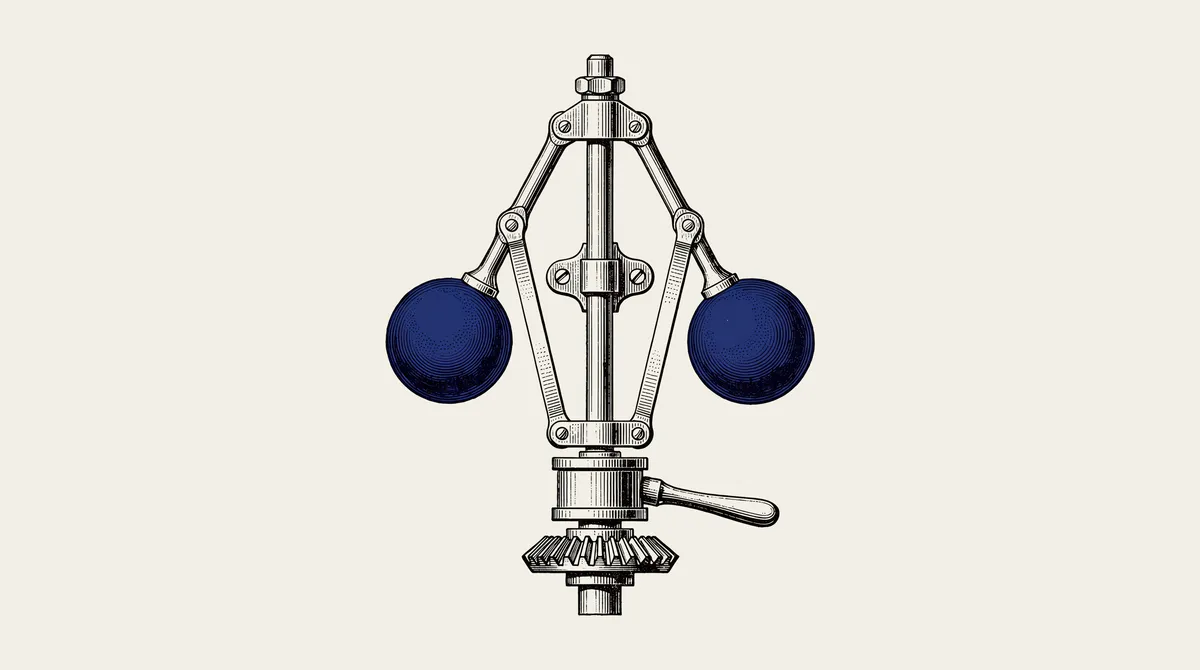
A governor, in the 1788 sense
A steam engine has no sense of how fast it is going. Left alone it accelerates until it destroys itself. The centrifugal governor solved that without understanding steam at all. It read one number, the speed, and closed a valve.
It sat outside the engine. It could not be argued with, because it did not listen. That is the whole idea, and it is two hundred years old.
Gubernaut is that device, for a system made of text. The controller reads the machine's own state and closes the valve. It never reads the prompt, which is why it cannot be talked out of stopping.
Gubernaut is two parts, and only one of them is token-free. The controller decides. The arbiter writes the reply, and it has to read the text to do that.
The controller's zero-token boundary is architectural and not yet adversarially tested. No jailbreak success-rate figure exists, because none was measured.
The steersman
Gubernaut is a compound of two old words for the same job. The Latin gubernare descends from the Greek kybernan, to steer. That is the root Norbert Wiener reached for when he named cybernetics. The lineage this work claims runs back to that founding: closed-loop regulation under pressure, measured in the open.
The name states the position. A navigator sits outside an engine that supplies force and no direction. It steers while the engine rows.
gubernare · Latin
To steer, to govern. The root of governor: the small device that keeps an engine from running away with itself.
nautēs · Greek
Sailor, voyager. The one actually at sea in the system while the weather does what it does.
What is built, and what is not
The drawing is the honest version of a roadmap. A line is solid only where there is a measurement behind it.
The ground floor is the cognitive layer, the one on this site: built, released and measured. The floors above it are declared and drawn dashed. The roof is embodied control, drawn dotted, because it is a direction and nothing more.
One principle, a branded house
One tier is built and measured. The rest are declared research directions, and the drawing says which is which.
A solid tier is built, running and measured in the record this site publishes. A dashed tier is declared and not built. The dotted roof is the direction the work is pointed at, and there is nothing measured behind it to report.
The engineer

Dushyant Sharma
Principal engineer and founder
Gubernaut is built by one engineer. Dushyant Sharma trained in mechatronics. There, mechanical systems, electronics and software are understood as one machine rather than three subjects. That training runs through machine learning, robotics, microcontrollers and control systems. Stopping a machine is a solved problem in that discipline.
Cognitive architecture came in from the other side, as a personal inspiration rather than a career plan. It began as a long study of how one regulates attention and impulse under pressure. The governor is where the two met. It restates that study as a deterministic control loop that could be built, instrumented and measured. Then it was put through a cross-family evaluation, pre-registered before any data existed, with its documented failure modes left in.
The architecture's design provenance is recorded in the paper. Read the research.
Where this goes
The ten-year position is embodied control. That is a direction, and the house plan draws it as one.

A governor that sits outside the thing it governs does not care what the thing is doing. It reads state and it closes a valve. Whether the runaway is a loop of text or a joint that will not stop moving changes the units, not the design.
So the same layer points at robotics. The work there is a research direction, drawn as the dotted roof above, and there is no measurement behind it to report.
One thing that direction has already made obvious. A failed grasp, a stale transform and a hostile sentence are not the same signal. They must not share a channel. A physical failure does not belong in the channel built for conversational pressure. Put it there and the control layer learns the wrong lesson.
Everything published on this site was measured on text. The record is the research.
What this does not claim
Gubernaut governs loop dynamics and the spend they cause, at the meta level, per turn.
not a content filter. It does not read, classify or block what the model says.
not a rate limiter. It severs on the controller's meta-state, not on a request count or a time window.
not a jailbreak defense. It reduces what an attack costs; it does not decide whether one succeeds.
not an evaluation harness. It governs a live request path and does not score models.
not a hosted service. It runs on your machine, in your request path, under Apache-2.0.
It is free, and it installs in one line.
Nothing here needs a conversation first. Run it against a real agent and see what it does.